
ADSS · Route changes
ADSS Route Changes: Can the Ordered Cable Still Be Used?
A moved pole or revised crossing can affect more than cable length. Reconcile the approved route with the proposed change before releasing existing ADSS cable and fittings.
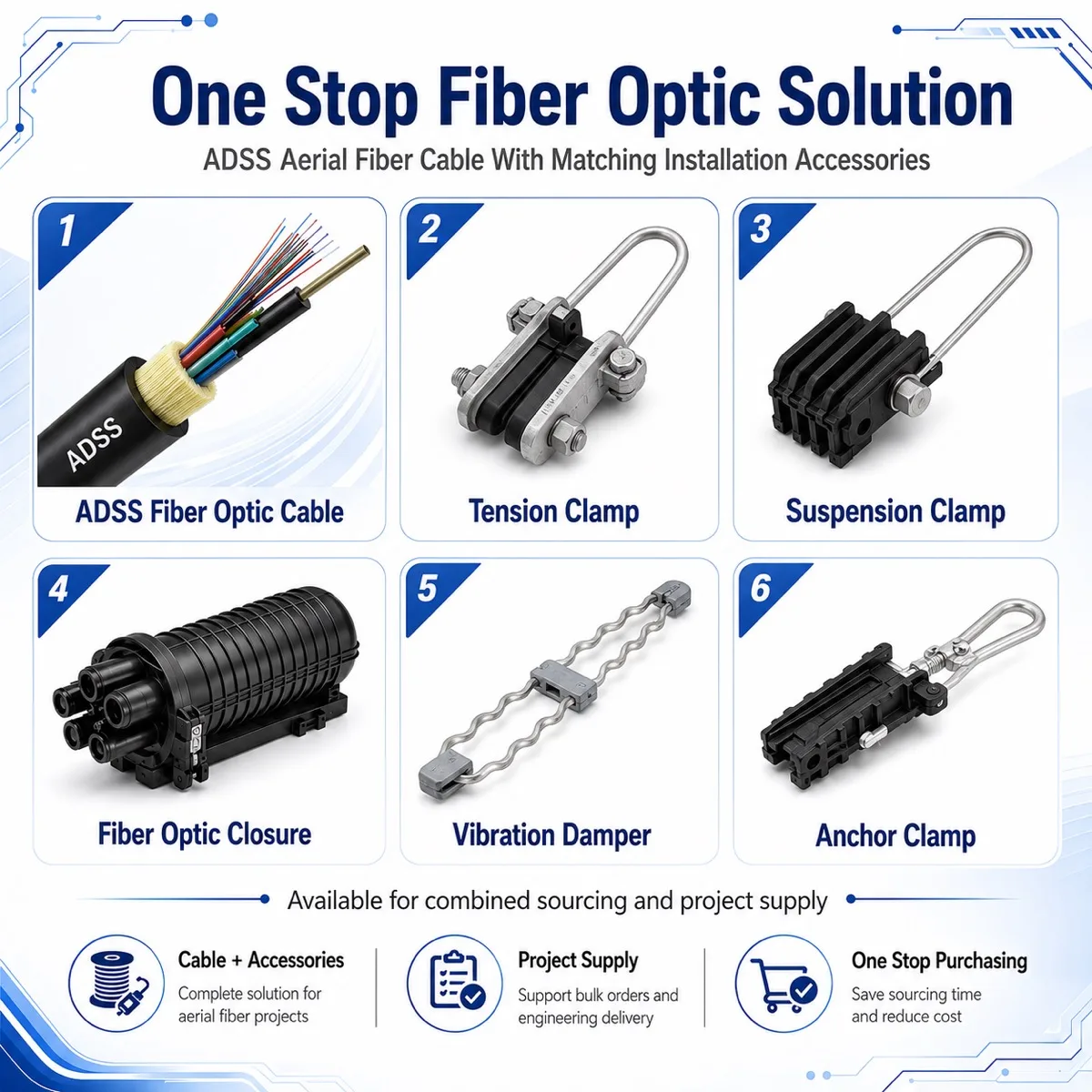
Direct answer: retain the order only after reviewing the changed conditions
An ADSS order may remain usable after a route change, but spare length alone is not enough to establish this. The responsible project engineer must compare the revised geometry, loading and attachment arrangement with the basis on which the cable and fittings were approved. Procurement then records whether each affected item is retained, reassigned, replaced or held. This guide controls a change to an existing order; it does not calculate sag, loading or clearances.
Define the affected section before changing quantities
Record the old drawing revision, proposed revision, reason for change and affected pole or crossing IDs. Include the adjacent spans and section boundaries that the designer identifies as affected. A moved support can change both adjoining spans; a new turning point can change the role of a support. Do not describe the entire change as 'another 30 metres' without showing its location and consequences.
Compare the design inputs, not just the longest span
Put old and proposed span lengths, changes of direction, attachment elevations and relevant environmental assumptions side by side. Ask the engineer which load cases and clearances need a new review. If a revised route moves closer to electrical infrastructure, submit the electrical environment and utility requirements as well. Neither an unchanged maximum span nor an unchanged fibre count proves that the earlier approval still covers the route.
Match the review to the actual purchased cable
Use the approved construction revision and supplier reference, not only the label ADSS. Confirm the finished diameter, mass and mechanical and sheath requirements relevant to the design. Changing to a cable with a higher tensile rating is not automatically a complete solution: the new construction may require different fitting ranges and installation settings. The designer and supplier should explicitly identify which earlier documents remain applicable.
Reconcile the fittings by support ID
Compare the original and revised support roles and the exact fitting references. Review diameter fit, the specified cable construction and the approved loading or angle application with the fitting supplier. A suspension arrangement should not be treated as a tension arrangement merely because the cable fits inside it. Corning's ADSS installation guidance illustrates why route geometry and hardware selection are connected; its particular dimensions and instructions are not UKCC product specifications.
Revisit lengths only after the route decision
Once the revised arrangement is approved, reconcile continuous section lengths, splice locations and end allowances against the assigned drums. A longer total inventory does not necessarily supply the longer continuous section required at one location. Use the existing splice allowance ledger to avoid counting the same reserve twice. Request a revised cutting or drum assignment only for the affected scope, retaining the traceability of unchanged lengths.
Use four explicit disposition outcomes
Retain means the existing item is approved for the revised use. Reassign means it is approved for another identified section, with the inventory record changed. Replace means an approved new specification is required. Hold means evidence or approval is missing; it does not mean the cable has been proven defective. Keep a disposition owner and document reference for each decision so the warehouse cannot mistake a commercial delivery instruction for technical release.
Control the timing with the factory and site
Tell UKCC whether the affected cable is awaiting production, already cut, dispatched or installed. Request written confirmation of feasible supply changes and their delivery consequences. Design approval, production feasibility and commercial acceptance are separate decisions. Installed equipment needs the operator's authorized work procedure; this checklist is not permission to retension a live route or work near power lines. The cover shows product options, not a certified combined assembly.
FAQ: The maximum span did not change. Can we skip the review?
No. Direction, adjacent geometry, attachment level or environmental exposure may have changed. Let the responsible engineer define the scope of review and document why existing approval remains valid, if it does.
FAQ: Can we use a stronger cable with the same fittings?
Only after confirming the exact cable and fitting combination for the revised design. Tensile rating alone does not establish diameter compatibility, installation settings or support suitability.
FAQ: Must the whole order be cancelled?
Not necessarily. A section-level disposition can preserve suitable items and isolate the changed scope. Do not cancel or substitute unaffected material until its actual use and approval are reconciled.
Route-change comparison register
| Changed field | Before and after evidence | Release decision |
|---|---|---|
| Geometry | Drawing revision, pole IDs, spans, angles and levels | Engineer confirms affected design cases |
| Exposure | Environmental basis and electrical/utility constraints | Requirements remain valid or are revised |
| Cable | Ordered construction, diameter, mass and approved data | Retain, reassign, replace or hold |
| Fittings | Support role and exact fitting/cable combination | Supplier and design compatibility confirmed |
| Lengths | Continuous sections, splice allowances and drum IDs | Approved quantity and cutting revision |
Six steps before releasing changed-route material
- Freeze the old drawing and identify the proposed revision.
- Mark every affected support and adjoining section for review.
- Obtain the engineer's updated design decision.
- Confirm the exact cable and fitting references against that decision.
- Reconcile approved sections with available drums and production status.
- Issue item-level dispositions and communicate the released revision to site and supply teams.
Keep the supporting schedules aligned
Technical background, not project approval
Check the change before releasing the order
Send the old and new drawing revisions, affected pole IDs, span and angle changes, approved loading basis, ordered cable datasheet and fitting schedule. Identify items already produced or installed.
Send the Route Change Comparison