
ADSS Procurement
ADSS Span Selection: What to Check Beyond Rated Tensile Strength
A route-first ADSS span selection guide covering pole geometry, wind, ice, temperature, sag, electrical environment, cable tension definitions and compatible fittings.
Why a span number is not a complete specification
A request for “24-core ADSS, 100 m span” gives a supplier a starting point, not a finished cable design. The longest span may appear only once on the route, while most poles are closer together. Wind, ice, temperature range, installation tension and the allowable sag all change the load carried by the aramid yarns. UKCC therefore asks for the typical span, maximum span and any road, river or valley crossings separately. That prevents a quotation for a light distribution cable from being compared with a cable designed for the most demanding crossing.
Separate telecom poles from power-line routes
The installation position matters. A self-supporting cable on telecom poles is not assessed in exactly the same way as ADSS installed within the electrical field of a power line. For a power-line route, provide the line voltage, proposed attachment position and any utility specification. These details help determine whether a standard PE outer sheath is suitable or whether tracking and erosion performance must be considered. IEC 60794-4-20 specifically addresses ADSS used along electrical power lines; ordinary self-supporting aerial telecom cables fall under a different application family.
Record the route conditions before requesting tensile data
Useful field notes include pole type, pole condition, terrain, prevailing wind, minimum temperature, expected ice if applicable, route elevation changes and the number of sharp direction changes. Photos of the longest spans and corner poles are often more useful than a general route description. Rated tensile strength, maximum allowable tension and everyday operating tension are not interchangeable figures, so a buyer should ask which value appears in a quotation and what loading case it represents.
Match hardware to the actual cable and pole
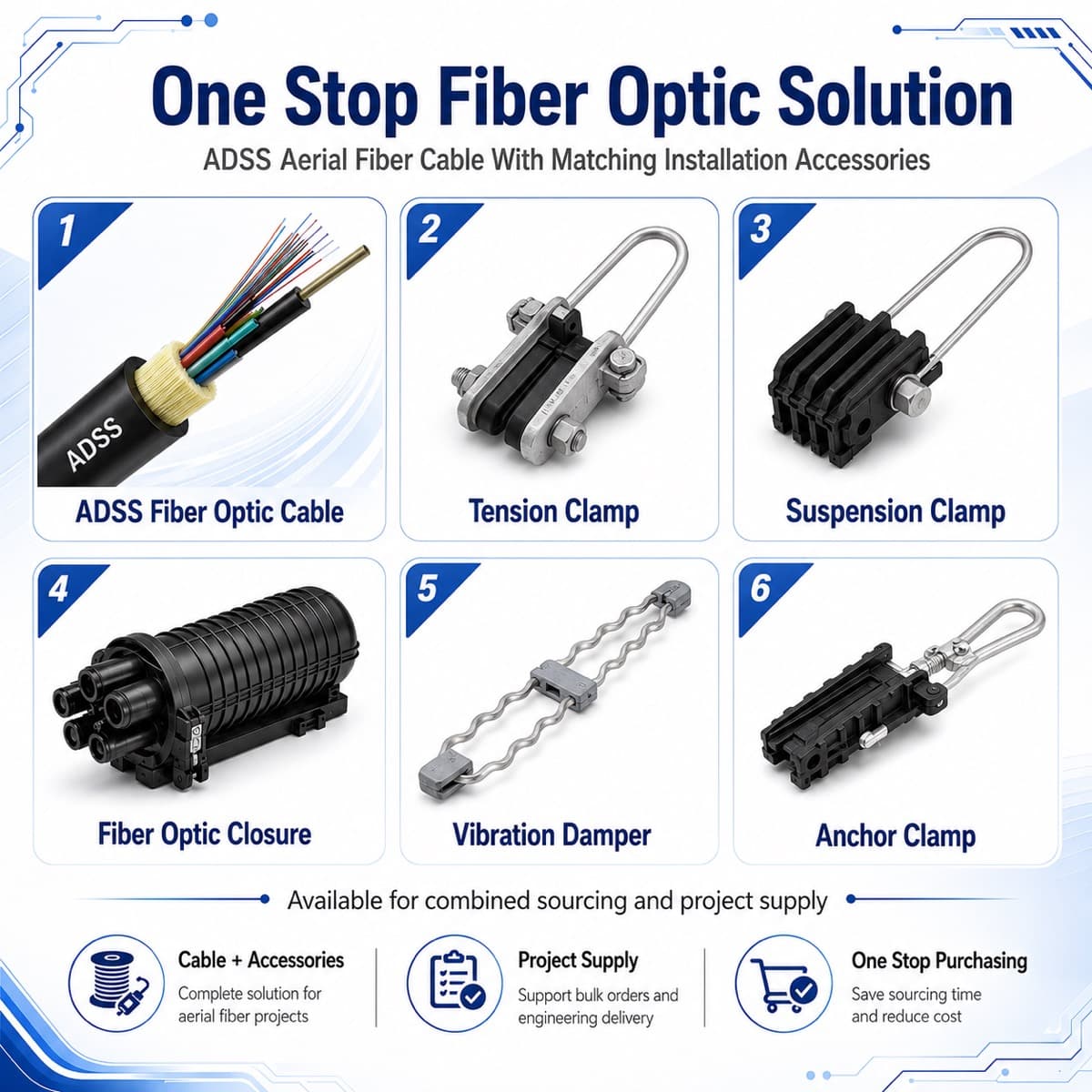
Suspension and dead-end hardware should be selected after cable diameter and tensile design are confirmed. The inquiry should state whether the project needs tangent supports, dead ends, down-lead clamps, storage brackets or vibration protection, as well as the pole material and attachment arrangement. Buying clamps from a generic diameter range without checking the cable can produce excessive local pressure or poor grip. For a project quotation, UKCC treats the cable and its main aerial fittings as one route package rather than unrelated line items.
Confirm fibre, drum and marking requirements
After the mechanical route data is clear, confirm fibre count, fibre standard, maximum cabled attenuation, drum length and jacket marking. ITU-T G.652.D is widely specified for outdoor access and backbone links, but the project document remains the controlling requirement. Drum lengths should follow splice locations and handling limits instead of being chosen only to minimize the number of drums. Include the destination, reel orientation, sequential metre marking and any customer name or project code required on the sheath and drum label.
How to compare two ADSS quotations
Compare the proposed application, cable diameter and weight, tensile definitions, sheath type, fibre performance, drum length, hardware scope and test documents on the same sheet. A lower price may simply exclude fittings, use a different tensile basis or assume a milder span condition. Ask the supplier to record every assumption that was not supplied in the RFQ. This makes technical review faster and reduces the chance that a price is accepted before the longest span or installation environment has been checked.
A compact ADSS RFQ that a factory can use
Send a route drawing or pole schedule; typical and maximum spans; power-line voltage and attachment position when relevant; wind, temperature and ice conditions; fibre count and fibre standard; route length; required drum lengths; pole photos; hardware scope; destination country; and the applicable project standard. If some values are unknown, mark them as unknown rather than guessing. UKCC can then identify the missing design inputs before confirming a construction and commercial offer.
Need help choosing a product?
Send the route, fiber count, quantity and destination country. UKCC Fiber can help match the cable and related FTTH materials.
Request Project Support