
CIS · Cold-weather installation
Cold-Weather Fiber Cable Installation: A Release Checklist
A low operating-temperature rating is not permission to unwind cable in the same conditions. Separate storage, installation and service limits before releasing a winter work section.
Direct answer: release against installation conditions, not service temperature
For a cold-weather CIS route, obtain separate storage, installation and operating limits for the exact cable construction. Then confirm how the manufacturer requires the drum to be stored, conditioned, transported and unwound. A service-temperature statement describes the installed cable under its stated conditions; it does not by itself authorize bending and tensioning a cold drum. Keep the work section on hold when the installation limit or handling instruction is missing.
Why the three temperature ranges answer different questions
Storage concerns a packaged cable before use; installation involves movement, bending and tension; operation concerns the completed route. Public Corning datasheets illustrate that these ranges can differ and that cable temperature matters before installation. Those figures belong to Corning products, not to UKCC cable. Request the approved datasheet and handling instruction for the quoted construction rather than borrowing a numerical limit from another model.
Create a release record for each work section
Record section ID, drum IDs, cable datasheet revision, planned handling method, declared installation range and who can authorize release. Add the storage location, transport interval, planned start time and measurement procedure agreed with the manufacturer. Do not invent a universal soak period: a large drum, its packing and the temperature history can differ from a small coil. Ambient temperature alone should not be treated as proof that all cable on a drum has reached the required condition.
Check the route and equipment independently
A cable within its declared installation range is only one release condition. The contractor must also assess access, footing, drum stands, rollers, communication between crews and the ability to stop safely. For ADSS, retain the approved sag-tension and fitting instructions; for duct work, use the approved pulling arrangement. Frozen equipment or a blocked route is not solved by choosing a lower cable service-temperature rating.
Agree handling limits before the crew is mobilized
Ask for the applicable minimum bend radius under installation load, pulling-tension limit, grip method and any restrictions on jacket handling. Corning's conduit guidance emphasizes manufacturer-specified tension and bend limits; it is a useful principle, not a transferable UKCC parameter. Record the project-specific values in the approved method statement. Do not use a field heating method unless the cable manufacturer has explicitly accepted it.
Manage interruption and restart as a new decision
If weather changes, the drum is left outside or the installation is paused, record the state of the cable and work section. Recheck the applicable conditions before restarting rather than relying on a morning signature. Quarantine a drum with suspected jacket damage or unexplained optical change for the agreed investigation. The acceptance plan should define required before-and-after records and the person who closes each exception.
What factory evidence can and cannot establish
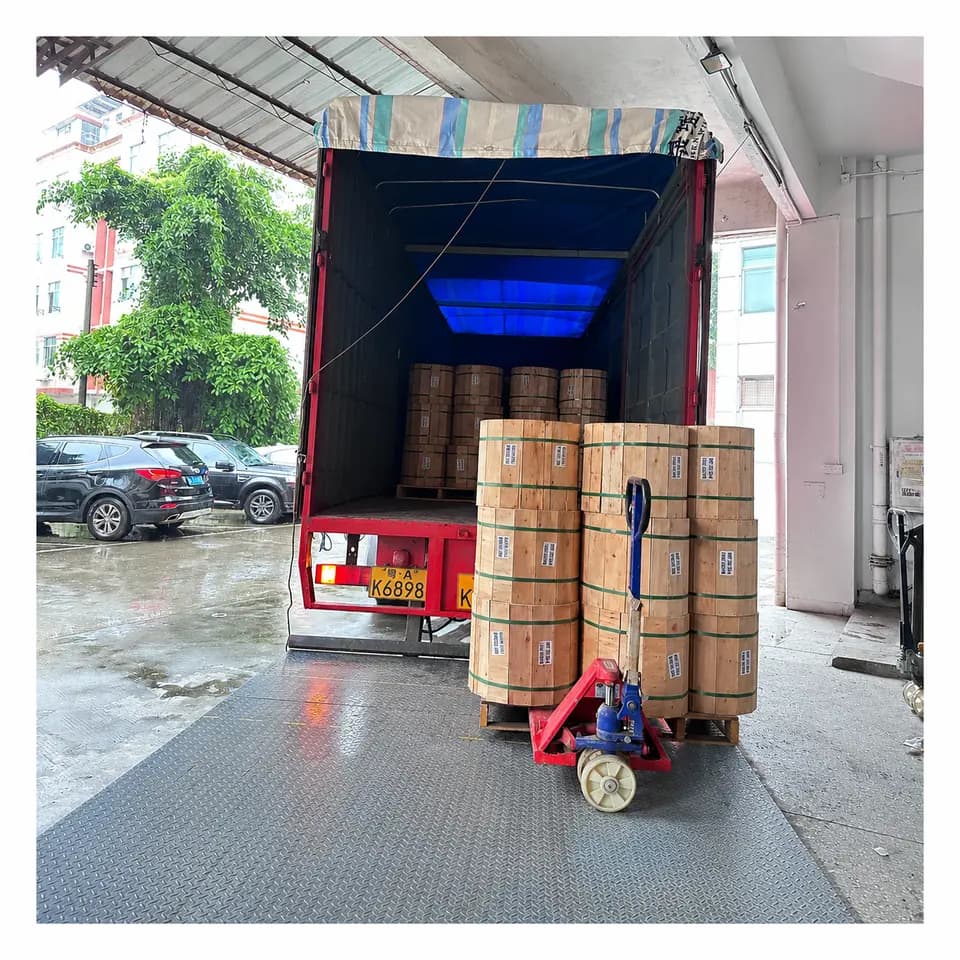
A drum label, construction drawing and agreed inspection record help identify what was supplied. They do not establish the temperature experienced during the contractor's installation. Keep supply records and field release records connected by drum and section ID. The cover photograph shows factory loading; it is not a CIS winter site, a low-temperature test or evidence of a particular temperature rating.
FAQ: Can I use the operating minimum as the installation minimum?
No. Ask for the separate installation limit and handling conditions for the exact cable. If only an operating range is supplied, the installation decision remains unresolved.
FAQ: Is a warmed warehouse enough?
Not by itself. Confirm the manufacturer's conditioning instructions and account for transport and waiting time before unwinding. Do not choose a universal number of hours without that instruction.
FAQ: Who approves a winter restart?
The project should name the responsible supervisor or engineer in advance. Supplier guidance defines cable limits; the contractor and project authority still control site safety, method approval and field release.
Three separate release questions
| Stage | Evidence to obtain | Do not assume |
|---|---|---|
| Storage | Packaging and storage-temperature instructions | A stored drum is ready to unwind |
| Installation | Declared range, bend/tension limits and conditioning method | The operating minimum also applies to handling |
| Operation | Approved installed-service range and route design | A cold-weather rating approves every installation method |
Pre-start checklist
- Match drum IDs to the approved cable datasheet revision.
- Confirm installation limits and any conditioning instructions in writing.
- Record storage, transport and waiting conditions using the agreed procedure.
- Check route access, equipment and cable handling separately.
- Name the release authority and stop/restart triggers.
Continue the route review
Technical context — not our product specifications
Confirm the winter installation inputs before ordering
Send the cable construction, planned installation dates, expected temperature range, storage arrangements, route method and project handling requirements. Unknown limits should remain open until confirmed.
Send Winter Route Requirements