FTTH Procurement
Indoor or Outdoor FTTH Drop Cable? Define the Building Entry Before You Buy
A route-based guide to indoor, outdoor and self-supporting FTTH drop cable, including jacket, strength member, span, termination and accessory decisions.
Draw the last 100 metres before choosing a model
The most useful FTTH drop-cable specification starts with a route sketch. Mark the distribution box, the aerial or wall section, the building entry, the riser or corridor and the customer outlet. A cable that performs well inside a protected corridor may not be intended for prolonged sunlight, rain or aerial tension. If one subscriber connection crosses several environments, the design may need an outdoor drop section, a protected transition and an indoor cable rather than one model used everywhere.
Indoor cable: check fire and installation rules
GJXH and GJXFH names are commonly used for flat indoor drop constructions, but the code alone does not prove compliance with a building requirement. State the required jacket material, flame performance, smoke requirement and local installation rule in the RFQ. IEC 60794-2 covers indoor optical-fibre cable families, while a tender or national building code may impose additional conditions. Also confirm whether the cable runs in conduit, a riser, a tray or directly along a wall.
Outdoor drop: separate support wire from strength members
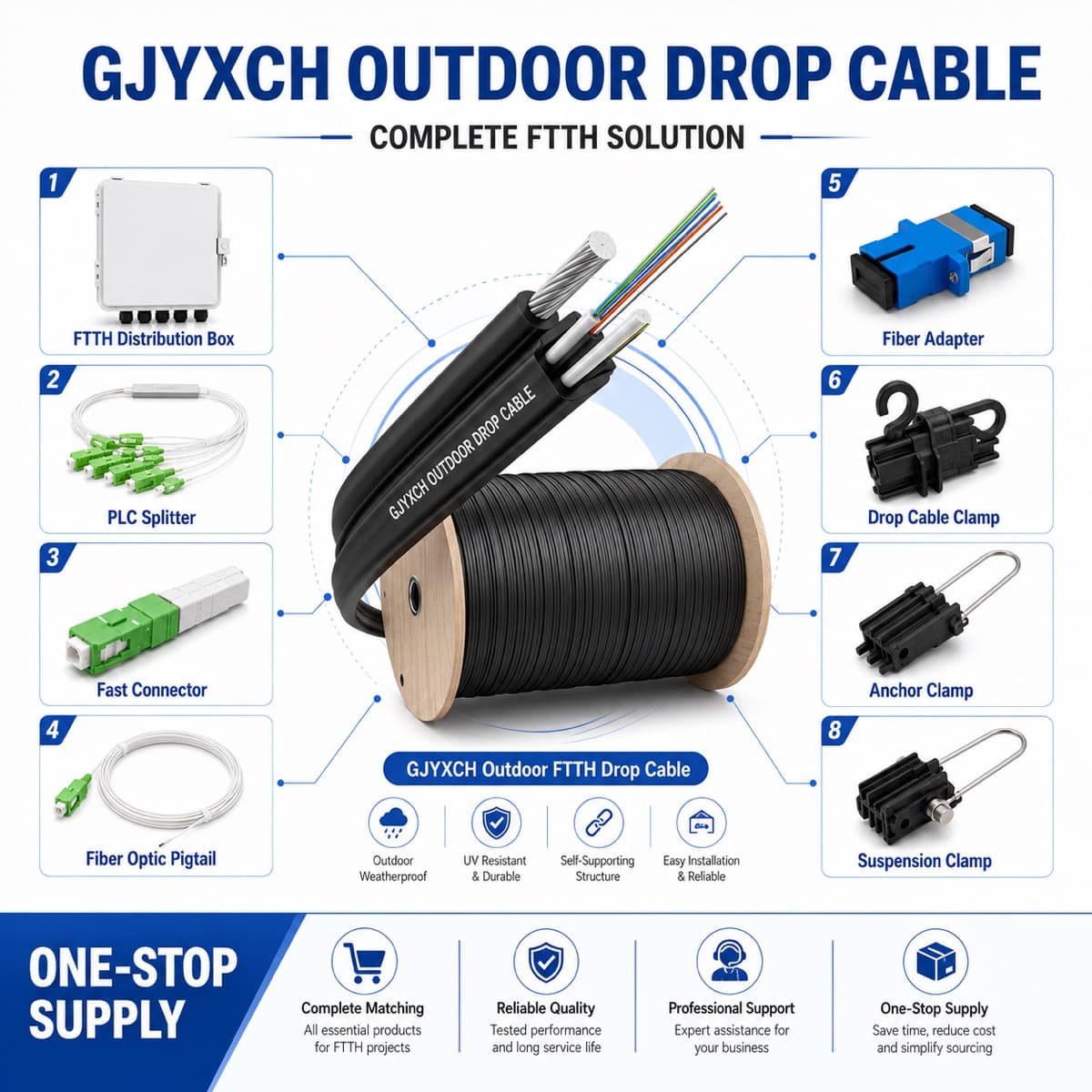
For an aerial last-mile span, buyers often request a figure-8 style GJYXCH or GJYXFCH cable. The external messenger carries the span load; the two strength members beside the fibre protect the flat cable body. These are different functions. State the pole-to-building span, attachment method, wind exposure and whether the cable continues indoors. A supplier cannot responsibly confirm an aerial construction from fibre count alone.
Steel and FRP solve different problems
Steel strength members provide stiffness and are widely used, but they make the cable metallic. FRP offers an all-dielectric option when electrical isolation or a non-metallic route is required. Neither is automatically better. Confirm lightning exposure, proximity to power conductors, bend handling, connector preparation and the project specification. Ask the supplier to identify both the messenger material and the parallel strength-member material instead of accepting the word “FRP” without context.
Termination changes the buying decision
A field-spliced pigtail, a mechanical fast connector and a pre-connectorized drop require different preparation and workmanship. Confirm the connector type, polishing, cable-end length, insertion-loss requirement and whether factory test records are needed. For field termination, request a stripping sample or installation instruction before a large order. A slightly different jacket or strength-member layout can change the installer’s stripping time even when the nominal cable size looks similar.
Order the route fittings with the cable
List anchor clamps for the building and pole ends, wall clips, protective conduit at the entry, distribution or terminal boxes, adapters, pigtails and patch cords. Clamp range must match the finished cable dimensions and messenger construction. Keep indoor hardware separate from weather-exposed fittings in the bill of materials. This simple route-by-route check prevents a container of cable arriving without the small parts needed to connect the first subscriber.
FTTH drop-cable RFQ checklist
Provide a route drawing; indoor and outdoor lengths per subscriber; maximum aerial span; fibre type and count; strength-member and messenger preference; jacket, colour and flame requirement; coil or reel length; printing; termination method; connector specification; clamps and boxes; quantity; destination; and the governing project standard. If the cable crosses the building boundary, ask the project designer to confirm the permitted transition rather than assuming an outdoor jacket can continue through the whole premises.
Need help choosing a product?
Send the route, fiber count, quantity and destination country. UKCC Fiber can help match the cable and related FTTH materials.
Request Project Support