
FTTH Project Planning
FTTH Bill of Materials: Build the List from Route Sections, Not Product Names
A practical method for turning premises count, splitter design and route sections into a checkable FTTH cable and passive-material schedule.
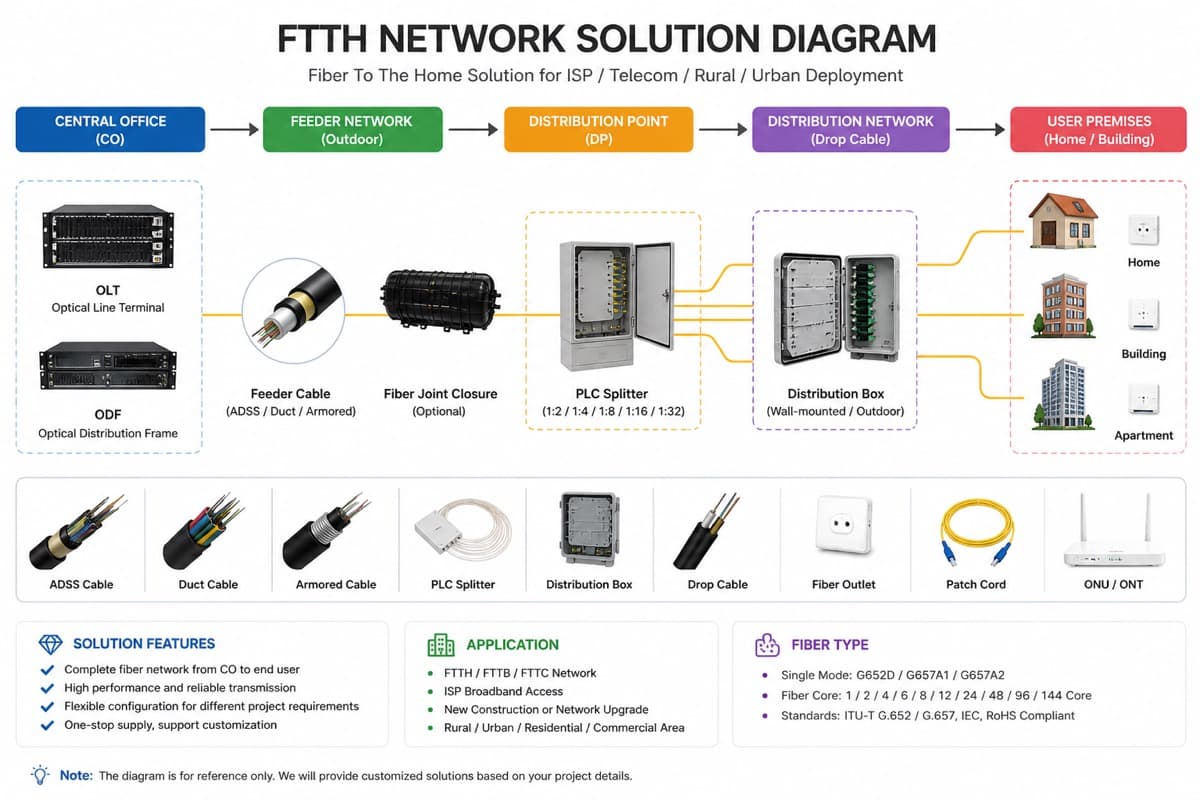
Freeze the network assumptions first
Record homes passed, initial connections, take-up forecast, spare capacity, central-office or POP location and the intended PON architecture. Then define splitter ratios and whether splitting is centralised or cascaded. A bill of materials cannot be checked if one person assumes 1:32 centralised splitting while another sizes boxes for two 1:8 stages. ITU-T L.250 provides topology terminology, but the operator’s optical budget and engineering rules control the project.
Divide the route into measurable sections
Create separate rows for feeder, distribution and drop sections. For each row record start and end point, route distance, installation method, fibre demand, spare-fibre policy, cable type, planned drum or coil length and joint locations. Separate aerial, duct, buried and indoor portions even when they belong to one link. This exposes transitions that need closures, entry protection or a different sheath.
Size cable from fibres and route conditions
The feeder fibre count must cover splitter inputs, network topology, reserves and possible future nodes. Distribution and drop counts follow their own service areas. After counts are known, choose cable construction from spans, ducts, pulling conditions, buildings and climate. Do not multiply subscriber numbers directly into a cable model without checking the splitter design, spare policy and physical route.
Map every splice and split point
For each closure, cabinet or box, record incoming and outgoing cable counts, fibre capacities, splice-tray capacity, splitter type, connector interface, adapter quantity, mounting method and environmental rating. Check whether splitters are bare, module, cassette or pre-connectorized. Connector type and polishing must be consistent across adapters, pigtails and patch cords; an SC/APC design should not receive an accidental mixture of UPC parts.
Build the subscriber-drop kit
A complete drop is more than a coil of flat cable. Depending on the method it may require an anchor clamp, wall clips, protective tube, building-entry seal, terminal box, adapter, pigtail, fast connector or pre-connectorized end and an indoor patch cord. Multiply kits by active connections, not only homes passed, and keep a controlled spare percentage. Confirm whether technicians receive individual kits or bulk cartons.
Add installation and restoration materials
List pole bands or brackets, suspension and dead-end fittings, cable storage supports, duct plugs, warning tape, markers, splice protection sleeves, cleaning materials and closure consumables. Some are locally sourced civil items; mark them clearly instead of silently deleting them from the BOM. Also identify test equipment and restoration spares, even when they are not part of the supplier’s quotation.
Run three checks before ordering
First, trace one complete optical path from OLT port to customer outlet and confirm every interface. Second, reconcile total cable length with route length, slack, risers, joint tails and waste. Third, reconcile splitter outputs, box ports, adapters, connectors and planned customers. Issue the supplier a controlled BOM revision with drawings, packing groups and approved equivalents so later changes are visible rather than hidden in email threads.
Need help choosing a product?
Send the route, fiber count, quantity and destination country. UKCC Fiber can help match the cable and related FTTH materials.
Request Project Support