
Kazakhstan · Route Engineering
Kazakhstan Rural Fiber Route Segmentation and Drum Planning
A route-first procurement guide for dividing Kazakhstan rural fiber links into standard spans, exposed crossings, duct entries and practical cable drum lengths.
Direct answer: divide the route before choosing one cable
For a Kazakhstan rural fiber project, do not select one ADSS span rating and one drum length for the entire line. First divide the route into repeatable pole sections, exposed or long crossings, duct or bridge entries, settlement approaches and terminal sections; then confirm cable construction, fittings, splice locations and drum lengths for each group.
Use public rollout plans as market context, not project evidence
Kazakhstan has announced continued fiber construction for rural settlements, including more than 1,100 villages in one public program. That confirms a real rural-connectivity need, but it does not mean UKCC supplied those projects. A buyer still has to provide the route survey, operator rules and environmental design basis for the cable being quoted.
Create a route-segment decision matrix
Standard tangent spans need typical span, pole type and attachment height. Exposed fields and road, river or railway crossings need maximum span, wind and ice basis, angle and clearance. Duct, bridge and building-entry sections need pulling length, bends, moisture and mechanical protection. Mark each section on one route drawing so a special crossing does not silently become the design assumption for every kilometre.
Separate climate data from a generic cold label
A minimum winter temperature alone cannot define an ADSS design. Record installation temperature, operating range, design wind, ice or combined load where applicable, altitude and open-terrain exposure. The network designer or operator should approve the load case. Suppliers can calculate against declared inputs, but should not invent missing weather or clearance requirements.
Build the drum schedule around installation fronts
For every drum, list route section, cable construction, fiber count, planned length, tolerance, start and end structure, splice point, gross-size limit and unloading method. Longer drums reduce splices but can exceed truck, road, crane or tensioning limits. Reserve and leader lengths should be visible rather than hidden inside an unexplained percentage.
Match fittings to the finished cable and route role
Suspension and dead-end assemblies must match the finished cable diameter, mechanical load and route angle. Identify tangent poles, terminals, corners, crossings, downleads, vibration protection and storage points. Do not purchase hardware from a span label alone; the proposed cable construction and fitting range must be checked together.
Use factory photographs honestly
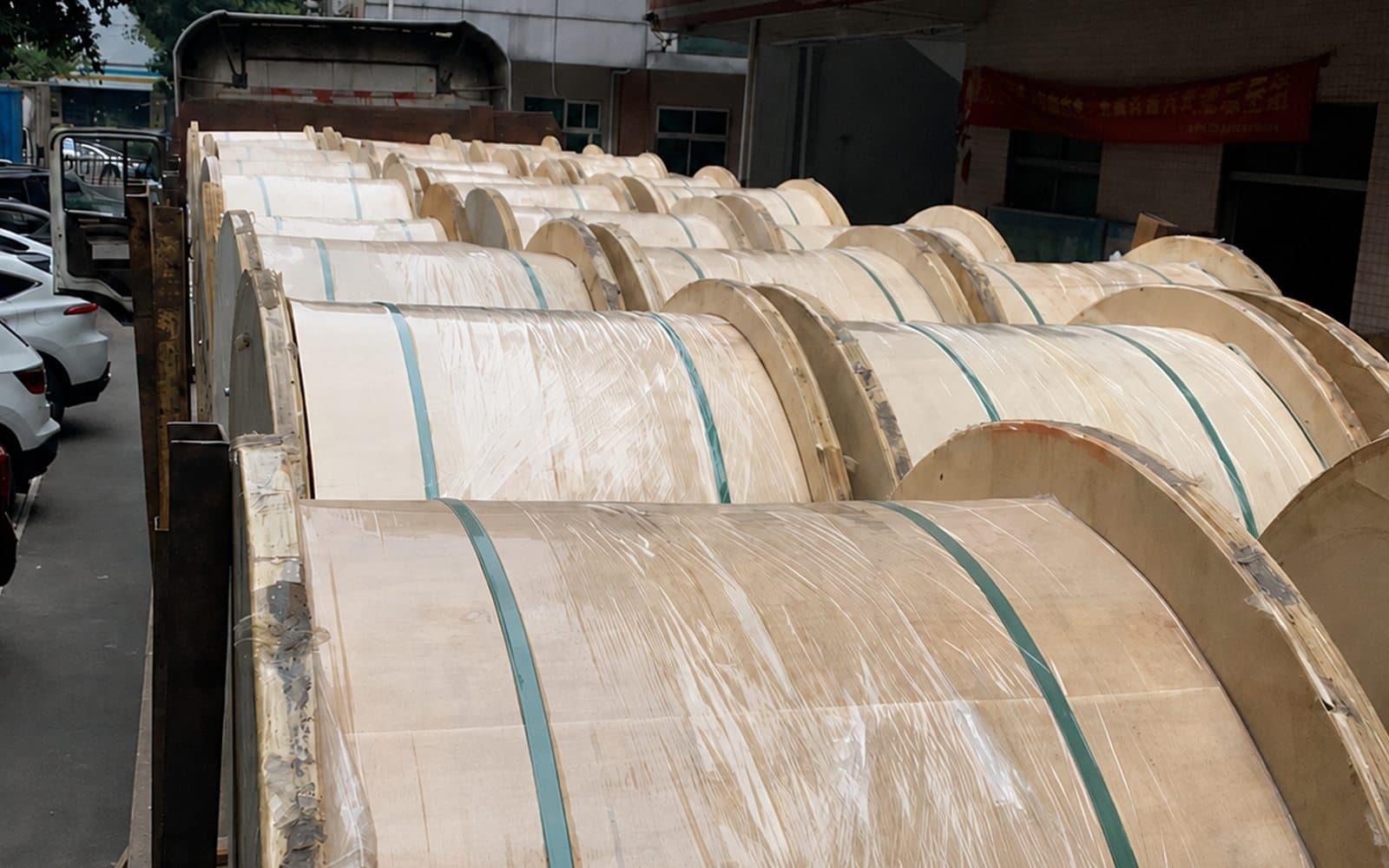
The cover image shows wrapped cable drums prepared at the factory for dispatch. It is production and delivery evidence, not a photograph of a Kazakhstan installation. Order-specific evidence can include approved construction, production identification, optical records, metre marks, drum labels and loading photographs when agreed in the inspection plan.
Route and RFQ checklist
Send a route map; total length; typical and maximum spans; every special crossing; pole material and condition; attachment height; line voltage and cable position when power poles are shared; wind, ice and temperature basis; fiber count; sheath requirement; fittings; splice philosophy; drum limits; printing; destination and required inspection records. List unknown items so the quotation states assumptions instead of hiding them.
FAQ: Can one ADSS design cover the whole rural route?
Sometimes, but it should be a documented engineering decision. If one exposed crossing governs a much stronger and heavier construction than the rest of the route, a separate section can reduce cost and simplify fittings, provided the splice and maintenance plan accepts the transition.
FAQ: Is the longest possible cable drum always better?
No. A longer drum reduces joints only when the access road, vehicle, unloading equipment, cable stand, pulling or tensioning plan and splice locations can handle it. Practical installation fronts should set the drum schedule before production.
FAQ: Can a firm price be given without wind and ice data?
A budget indication can use clearly stated assumptions, but final mechanical selection should follow approved route and load inputs. The supplier should identify missing data and avoid presenting an assumed span rating as a guaranteed design for an unreviewed route.
Build a route-based drum schedule
Send the route length, typical and maximum spans, crossings, wind and ice basis, pole data, splice plan and unloading limits. We can separate the cable and fitting requirements by route section.
Send Route Parameters